Are we there yet?
For generations we have been told that history is over and we are here only to watch the decline of our civilization, while the people on top keep asking like children, are we there yet?
- capitalism
- fascism
- politics
- materialism
"Tell no lies. Claim no easy victories."
- Amilcar Cabral
For generations we have been told that history is over and we are here only to watch the decline of our civilization, while the people on top keep asking like children, are we there yet? Like we all would ever know whether even that first premise is the truth, or only something you'd tell someone to convince them that actions are useless and nothing can or will change... Let's dive into why not only this is the wrong question to ask, but also how we might be closer than you would think to a pivotal moment and that history is being made every single second. Let's put our historical materialist goggles on and get going!
Decolonizing an economy
Let's start in West Africa, because there the question has a shockingly concrete answer. Picture Thomas Sankara for a moment; he ran Burkina Faso for just four years, and in that short time he vaccinated millions of kids without international aids, planted millions of trees against the desert pushing south, put women in leadership posts they had never touched before, and made the country grow almost all of its own food. Then in 1987 he was assassinated in a coup that smelled of Paris, and the lesson the world absorbed was brutal and simple: try to be sovereign, and you will end up six feet under. So when a 34-year-old captain named Ibrahim Traoré took power in 2022, honestly, nobody expected anything except a rerun.
Instead, we got something closer to Sankara's unfinished homework being picked back up. In 2025 the government announced the country feeds itself now; better seeds, subsidies, machines for the farmers, the boring, unglamorous stuff that actually works. That same year gold production smashed records at 94 tonnes, and here's the part that should make you sit up: the state mining company SOPAMIB is up and running, most of the industrial mines are now majority-owned by Burkinabè companies, and three belong outright to the state. In April 2026 the government finished taking over Sofitex, the cotton giant at the heart of the old export economy, and pushed public ownership from the mines straight into the fields. Oh, and together with Mali and Niger they walked out of ECOWAS and built their own bloc, the Alliance of Sahel States, whose entire reason to exist is keeping the surplus from quietly flowing north the way it has flowed since empire.
Now, the international press has had a field day with all of this, and none of it has been kind. When Traoré told state broadcasters his people should "forget about democracy," liberals everywhere gasped and reached for the dictator stamp. But hold on, because this is where it gets interesting; watch how the frame works. This is a region where imported elections delivered four coups in three years while French companies kept loading gold onto ships, so a guy rejecting an imported political formula tells you nothing about whether the people rule. The real materialist question is whether power actually flows through the hands of peasants and workers, and that verdict doesn't get issued from editorial offices in London and Paris. This doesn't mean the criticisms vanish into thin air; it means we judge them in context, using our own eyes, with the vocabulary of the folks who live on the land instead of the vocabulary of the people who used to own the mines.

Surviving as a method
Let's now go over the Caribbean, ninety miles off Florida, where a country of eleven million has been running a stress test six decades long. Cuba has taken a blockade, sabotage, an invasion, and every flavor of isolation for over sixty years, and somehow the island hasn't folded into capitalism, and somehow it hasn't frozen in place either. It trains doctors by the tens of thousands and sends them wherever the market refuses to go; it brewed its own COVID vaccines while the rich world hoarded the doses; it keeps fighting for its interests while permanently under siege. Nobody should pretend this is prosperity, and I won't insult you by waving away the blackouts and the empty shelves Cubans live with; but pay attention to what bare survival proves. A besieged revolution that lasts sixty-five years is, just by existing, telling you the pressure to give up can be outlasted.
Imperfect movements, long games
And then there's China, the case the entire imperial press corps desperately needs you to dismiss, and the numbers refuse to cooperate. Roughly 800 million people climbed out of extreme poverty over four decades, and those are World Bank figures, not Beijing's press releases; that single sentence describes a transformation of material life with no precedent anywhere in the capitalist world, ever. Look at what the machine produces today: by the end of 2025 China had about 640 gigawatts of wind and over 1,200 gigawatts of solar installed, a clean power fleet more than half the entire planet's; it commands roughly 70 percent of global clean-tech manufacturing and nearly 85 percent of battery production, per the Los Angeles Times' own accounting; in a single month it exported 68 gigawatts of solar technology, records being broken not incrementally but by fifty percent jumps, with the biggest growth flowing into the Asian and African countries the old order wrote off as permanently dependent. Even the New York Times, grudgingly, titled a briefing "China's Green Triumph." While Washington renegotiates which oil pipeline gets blessed this decade, a socialist state engineered the collapse of the global price of solar panels, batteries, and electric vehicles, and in doing so handed every developing country on Earth a way out of the fossil fuel hostage situation the empire built. That is what a planned economy looks like when it works, and no amount of hand-wringing editorials changes the physics.
Are there problems? Of course there are problems, it's a society of 1.4 billion people in motion, inequality among them is real, and Chinese people debate all of it loudly; anyone who pretends otherwise is selling you something. But notice how the ledger gets kept. Western media spent seventy years declaring China's failures fatal and its successes fraudulent, and through all of it the state kept planning, kept building, kept correcting course across generations, which is precisely what the current wave needs to internalize. Revolutions show up unfinished; they trip, they eat their own mistakes, they adjust. Keep that in your pocket, because it comes back at the end.

The youth aren't afraid of the word
Meanwhile, something quieter and maybe sneakier has been brewing inside the old imperial cores. Gallup reported in 2026 that 43 percent of Americans view socialism positively, the highest since they started asking in 2010; among adults under 35, it's 57 percent. A Cato survey found 38 percent of under-thirties have a warm spot for communism, nearly double the adult average. Words that used to end careers are now painted on protest signs.
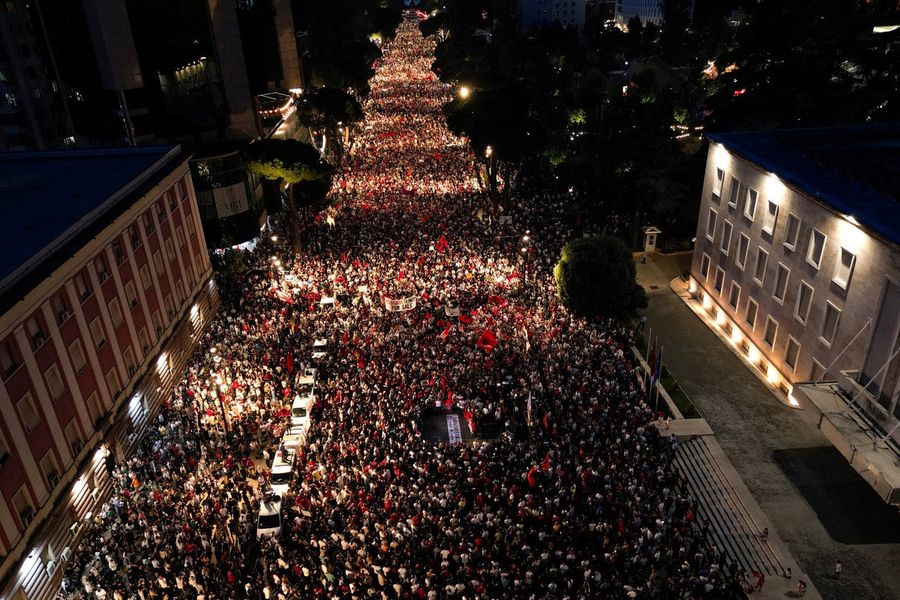
But this year the mood turned into muscle, and the results landed hard. In France, students flooded the streets through October in a wave of generational rage their grandparents were taught to be ashamed of. In Serbia, a student movement born from grief and fury over a corrupted railway canopy collapse in Novi Sad spent two years blockading universities and filling squares until the institutions cracked; when snap elections came in October 2026, their candidate list, packed with people who had never held office, ended Aleksandar Vučić's twelve-year rule outright. And in Albania, the whole thing reads like a fable about how empire operates now: Jared Kushner and Ivanka Trump, the sitting American president's family, fast-tracked a $1.4 billion luxury resort on Sazan Island, a protected shoreline dotted with unexploded ordnance, plus a second development squatting on the Zvernec wetlands where the flamingos live; environmentalists rose up in May, the resistance swelled into the "Flamingo movement" against the entire rotten apparatus of corruption that lets billionaires carve up a small country's coast, and by October the students had fused with it, clashing with police for weeks over university conditions, education costs, and everything the rot stands for. Rama refused to resign, burned government buildings and all, and tried the oldest trick in the imperial playbook, blaming shadowy Russian and Iranian meddling for what is plainly people who have had enough. Old parties like Die Linke, which doubled to 123,000 members and overtook Germany's Social Democrats in the polls, are riding a wave they didn't create. The kids are done asking politely, and one government in Europe has already fallen because of it, with another one wobbling.
Pressure valves
Which dumps us right into the part of the map that deserves our suspicion instead of our applause. It has become fashionable for mainstream outlets to suddenly "discover" socialism whenever a charismatic candidate wins a big city or rides high in a primary, and it's worth asking what that discovery is actually for. What we observe is that figures like Mamdani, Sanders, and AOC work, above all, as instruments and capital learned to install relief valves right into the boiler. A self-described socialist wins office; the movement's enormous energy gets poured into votes; the votes get poured into a city hall managing rents, policing, and budgets for capitalism; and underneath it all, the property relations don't budge an inch. Socialists who govern end up stabilizing the very system they promised to threaten.
And the deeper danger is the one we carry inside: the sweet, seductive belief that winning an election is the finish line. History shows up with a bat for anyone who believes that. Parties that grow fast attract careerists like flies; movements that succeed get funded, NGO-ified, and steered into politely petitioning the very institutions they set out to bury. Co-optation never knocks on the door announcing itself; it shows up wearing the costume of funding, respectability, and a seat at a table where nothing structural is ever served. And honesty demands we point the same flashlight at our own side. Grown-up movements audit their friends with the same rigor as their enemies.

From the river to the sea
Nothing in this century has taught my generation more about how the machine works than Palestine, and that hundred-year story, from Balfour's pen through the Nakba to the courtrooms of The Hague, deserves its own centerpiece and it will get one. What matters here is what the world is doing while the massacre unfolds, and I choose the present tense deliberately, because the empire would love nothing more than for you to file this under history.
So look at what is happening, right now, all over the planet. Millions are marching, from Jakarta to Rabat, from London to Cape Town, week after week, month after month, at a scale cities haven't seen in a generation or more; Pretoria is the one that dragged the word genocide into a courtroom while Washington holds the doors shut; Bolivia has cut ties outright and government after government keeps recalling its ambassadors; boycott campaigns are hitting Western brands harder than any protest in decades; dockworkers keep refusing to load weapons shipments; and campus encampments keep popping up faster than administrations can clear them. Wherever the crowds gather, the police gather too, and it's worth being plain about what that is: people being paid to suppress people who are mourning. This is history being made every single second, exactly as I promised in the opening, and the empire knows it; that's why its answer is the veto, then more vetoes, then sanctions against the court itself. But the valve has already jammed, publicly and permanently; every crackdown, every fired academic, every supply chain interrupted is teaching another hundred thousand people what the words are for and who they protect. Of all the pressure valves in the whole machine, this is the one you can watch jamming in real time.
History, every second
So, are we there yet? Honest answer, "there" isn't a place, and the question smuggles in a finish line that doesn't exist. But look at the picture we just walked through and tell me you see nothing, a Sahelian state pulling its cotton and its gold back into its own economy, an island under siege still minting its own doctors and cooking up its own vaccines, a fifth of humanity dragged out of destitution by a revolution that is still, right now, correcting itself, a people sealed behind a blockade who turned the conscience of a generation inside out, with the generation still answering, and in the belly of the empire a majority of those now coming of age hearing the word "socialism" and simply not flinching.
So what does somebody reading this on their phone actually do with it? Nothing cinematic, that's the first honest thing to say. You don't need to wait for a leader or a party to hand you a permission slip, because every example in this piece started with people doing unglamorous work close to home, the Serbian students who spent two years in assembly meetings nobody televised, the Albanian environmentalists who showed up to defend a wetland in May without knowing October was coming. Find the people near you who are already doing the work, a tenants' union, a food distribution, a strike fund, a neighborhood assembly, and lend them your evenings. Learn the budgets, the land deals, the zoning maps of your own town, because empire is never only out there, it's in the contract your city council signs next Monday, and it withers under daylight. And if you're the one inside the town hall, do the quiet revolutionary thing, open the data, publish the budget, answer the question before it's shouted. Information is the one weapon they can't confiscate, and it compounds like interest in the hands of people who share it.
And here's the thing, none of this needed a hero descending from anywhere. Material conditions did the teaching, housing costs, debt, climate, the quiet theft of a future, these are better instructors than any propaganda department, and they run classes around the clock. That's what historical materialism actually predicts, consciousness follows necessity. The wave freaking out the talking heads is younger than they are and far more patient than anyone gives it credit for, and it understands something they refuse to grasp, history is being made every single second, and lately, in more corners of the planet than one, it's being made on purpose. So to the kid in the back seat still asking if we're there yet, we were never going to arrive at a place somebody else built, and the fact that people everywhere have started building their own is the surest sign yet that this trip is finally headed somewhere.