Palestine: The Colony, Appraised
Part one: the building of the wall, from a London letter to an iron foreign policy
- fascism
- materialism
- palestine
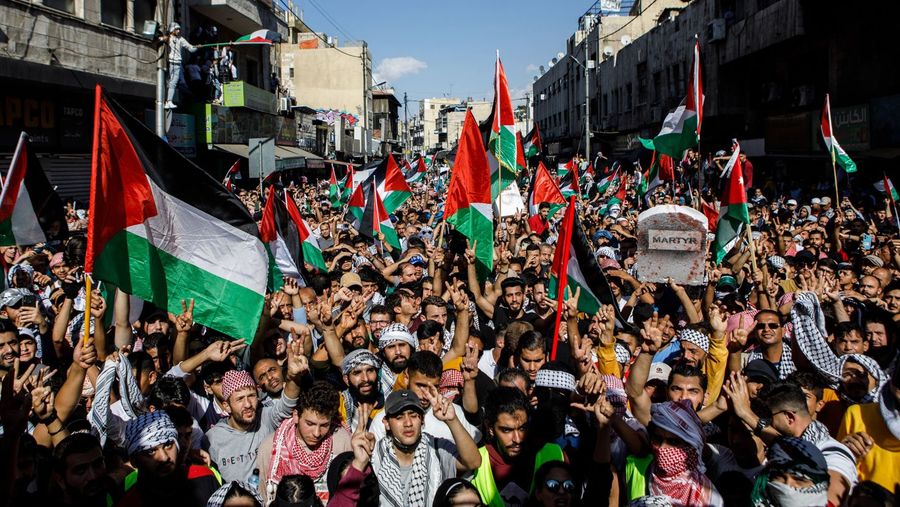
"We cannot forget, and we must not forget. The national identity of the Palestinian people is not a concept of the past; it is a vision for a future."
- Mahmoud Abbas
Sixty-seven words
On 2 November 1917, in a house in London, Arthur Balfour handed Lord Rothschild a letter of sixty-seven words. Britain, then a government with no territorial claim to Palestine, declared its support for "a national home for the Jewish people" in Palestine, with the caveat, written into the same sentence, that nothing should be done to prejudice the civil and religious rights of the "existing non-Jewish communities" already living there. It is worth dwelling on that caveat, because the whole story that follows lives inside it. The people who were already there were mentioned once, in a subordinate clause, and then the subordinate clause spent the next century being violated. Notice also what kind of object was being promised: a home, a thing with title, on land whose inhabitants held theirs by a use Britain did not bother to consult. Rights and refuge are nowhere in it. Whatever sentiment surrounds the letter, tenure is what it actually handles.
The iron wall
Six years after that letter, a Russian-born Zionist named Ze'ev Jabotinsky sat down to write about the people living in Palestine and whether their consent mattered. His answer, published in 1923 as "The Iron Wall," was that it did not and never would. The natives, he wrote, always resist colonists, no matter how decently the colonists behave, and so "Zionist colonisation must either stop, or else proceed regardless of the native population," under the protection of "an iron wall, which the native population cannot breach." Notice the vocabulary. Colonization was not an accusation hurled by hostile critics; it was the movement's own word for itself, the word printed in the names of the institutions financing settlement, and Jabotinsky used it deliberately, comparing the enterprise to the Pilgrim Fathers and, without flinching, to the companions of Cortés and Pizarro. What startles a reader today is the candor; he said aloud what the diplomatic correspondence knew how to disguise. His faction, Revisionism, the tradition of Begin and Shamir and eventually Likud, was long treated as the movement's rowdy fringe, the people who failed to grasp that certain things should not be said in public. The doctrine won anyway. An iron wall of soldiers and settlements is no longer a provocative essay from 1923; it is the operating theory of the state, the standing assumption that the people inside the wall understand only force and will acquiesce once they see it cannot be breached.

The promise, and what it cost
Britain kept Balfour's promise and forgot his caveat. After the First World War the League of Nations handed London the Mandate for Palestine, and immigration from Europe accelerated through the 1920s and 1930s while the Arab majority watched the demographic floor shift beneath it. There was an uprising in 1936 that lasted three years and was crushed. After the Second World War, with the surviving remnant of European Jewry in displaced persons camps and British authority collapsing, the United Nations voted in 1947 to partition the land. War followed the vote. What Palestinians call the Nakba, the catastrophe, produced around 750,000 refugees and the destruction of most of their villages, and the state of Israel emerged in 1948 holding far more of the territory than the partition plan had given it. Strip the sentiment from the term and look at the mechanism: population transfer is the cheapest form of land acquisition, violence the administrative instrument, and ruins the paperwork. The refugees and their descendants never got the right of return their grandparents were promised under international law, and that unresolved mass of stateless people is the spine of everything that came after.

The permanent condition
Then 1967. In six days of June, Israel occupied the West Bank, Gaza, East Jerusalem and the Golan, and the occupation became the permanent condition we still live with. Settlements began within months, in open violation of the Geneva Conventions, and they never stopped; the wall was being built in brick before it had finished being built in argument. A settlement is a house with a mortgage, a road with a commute, a hillside removed from one people's inventory and added to another's, financed, insured and defended, and at that scale diplomacy is just slow-motion transfer. The Oslo Accords of the 1990s promised a negotiated end to the occupation within five years, with a final agreement by 1999; instead the settlement population multiplied several times over while the negotiations produced ceremony rather than statehood. For three decades the international position hardened into a ritual: condemn the occupation, fund the humanitarian relief that the occupation makes necessary, and change nothing. Gaza meanwhile was sealed, bombarded at intervals, and subjected to a blockade that even its architects described in mathematical terms, calories per person per day, calibrated to keep the population alive but not nourished. A blockade is also an economic instrument; it fixes the ceiling of what an economy inside it can become.
The wall, as advertised
Violence, in other words, was the water everyone swam in long before the morning it became news. Palestinian resistance took the forms available to a people walled in, from intifadas to rockets, and each round was counted, mourned, and used to justify tightening the wall a little further. On 7 October 2023, Hamas fighters crossed into southern Israel, killed around 1,200 people and took 253 hostages, the deadliest single day for Jewish civilians since 1945. What followed was the wall operating exactly as advertised. Israel answered with a campaign on Gaza that has no recent comparison for intensity on so small and crowded a strip of land, a complete siege of food, water and fuel announced in its first days, and a war whose cumulative toll has passed 75,000 Palestinians killed according to figures verified by independent statistical work built on the Gaza Health Ministry's own records. Here it is worth pausing on the number, because the number itself became a battlefield. The ministry's tallies were dismissed for two years as propaganda by people who had never examined them, and then, quietly, in January 2026, an Israeli military official accepted that roughly 70,000 had been killed by Israeli fire, a figure since revised upward on the ministry's own documented lists. A study by the UN human rights office found that seventy percent of the Palestinians killed in their own homes were women and children. When the party doing the killing concedes the arithmetic of the party it accused of inventing it, the argument about numbers is over; what remains is the argument about whether the process they belong to can continue.
A word that works alone
The word terrorism deserves its own inspection, because it does a great deal of quiet work in this story. Hamas has sat on the United States' list of Foreign Terrorist Organizations since 8 October 1997; the movement was born in 1987, during the first intifada, as an outgrowth of the Muslim Brotherhood in occupied Gaza. A designation of that kind performs a kind of surgery on history: it removes an organization from the circumstances that produced it and presents its violence as rising from nowhere, an ancient hatred with no address. And the surgery is performed on one side only. No government on earth designates the IDF a terrorist organization, though the difference between the two kinds of violence is hardly what the label implies. Hamas's attacks, however one judges them, arrive in episodes, while the IDF's killing is codified into standing procedure. Soldiers and officers told the Israeli newspaper Haaretz they were under orders to fire on unarmed crowds at food distribution sites, threat or no threat, hundreds killed; "it's a killing field," one said, "our form of communication is gunfire." Intelligence officers described a bureaucratic apparatus that assigns each target a permitted number of civilian deaths, a ratio that rose at times to twenty for a single low-ranking militant. That is written procedure, signed off by lawyers, and defended in public without embarrassment. The dialect, however, is managed carefully. Violence from the designated side gets explained as pathology and answered with a list, while violence from the sponsoring side is written down as policy, staffed and budgeted like any other government program.

The arsenal and the shield
None of this could operate on its own steam, and pretending otherwise flatters everyone involved. The United States is Israel's largest arms supplier by a wide margin, a position it has held for decades, and unlike its European partners it does not even recognize the jurisdiction of the World Court. Follow the money past the press releases and the "aid" dissolves into something more familiar. Israel receives roughly $3.3 billion a year in Foreign Military Financing plus another $500 million for missile defense, and that money is contractually bound for American factories: about 92 percent of it must be spent inside the United States in 2026, one hundred percent by 2028, an arrangement no other recipient operates under. The "foreign aid" never leaves the American economy. It is a circular payment from Washington's ledger to its defense contractors' order books, with a war in the middle, and the consumption that keeps the contracts flowing, in Gaza, is the point at which the accounting becomes blood.
When the Security Council gathered during the famine and voted, for the sixth time in two years, to demand an immediate ceasefire, fourteen members voted yes and the United States vetoed it, alone, in September 2025. That was not a new reflex. The overwhelming majority of American vetoes at the Security Council, going back generations, have been cast to shield Israel from criticism of its conduct in Palestine. The veto is the political form of the same material relation: the guarantor's share of ownership expressed as procedure.
Europe plays the same part with a softer accent. Germany is the second-largest supplier of arms to Israel, accounting for about a third of its imports in recent years; between October 2023 and mid-2026 Berlin licensed roughly 1.5 billion euros in exports, and the licensing accelerated after the ICJ's first rulings. When Nicaragua brought the unprecedented case against Germany itself, accusing it of aiding genocide by arming the perpetrator, Germany responded by testifying in Israel's defense and, by one documentary trail, coordinating that testimony with Jerusalem. Chancellor Merz's partial embargo in August 2025 lasted about three months before the shipments resumed, on schedule, after the truce. This is co-production, a war materially underwritten by NATO governments who then convene earnest press conferences about peace, and the posture of the helpless Ally is part of the production.
And the intimacy runs deeper than weapons shipments. Jabotinsky reached for the Pilgrim Fathers as his exemplar, and the compliment has been returned ever since. Since 2002, thousands of American law enforcement officials, police chiefs, ICE agents, Border Patrol, FBI, have trained in Israel alongside Israeli police, soldiers and the Shin Bet; Georgia's GILEE program alone has run such exchanges since 1992. Amnesty's researchers describe what circulates in these programs: racial profiling, mass surveillance, the suppression of protest and dissent, the accumulated craft of policing a population you consider internally hostile. The resemblance that critics are always accused of imagining, between the treatment of Palestinians under occupation and the treatment of Black and brown communities at home, is an institutionalized curriculum, exchanged by professionals, documented by human rights organizations, and defended on the program's own website as cooperation. The United States arms the wall and recognizes it, because it wrote the original, a continental conquest retold at home as the birth of a free nation.

What the reader carries
Pause here and take stock of what the first half of this record establishes, because the empire prefers that it stay scattered. Every fact assembled above comes from official filings, sworn testimony, court records and the reports of the empire's own human rights apparatus; the war chest and its destination factories are public budget lines, the vetoes are entered in the Security Council's minutes, the training exchanges are advertised on government websites. Nothing here was leaked or discovered. It was declared, and then declared again, on the reasonable assumption that declarations accumulate into background noise. That is how impunity on this scale actually operates in our century: less through secrecy than through repetition and dispersal, each atrocity arriving alone, stripped of its supply chains, until a hundred separate scandals never manage to assemble into a single indictment of the system that funds them. The work of reassembly is the reader's work too. Carry these facts into the rooms where the war is discussed as a tragedy nobody could have foreseen; cite the budget lines, the veto counts, the ratios; insist on the connective tissue, because the connective tissue is precisely what the silence is made of. The second half of this record follows the paper trail into The Hague, where the highest courts of the very same order were handed the chance to say what all of this amounts to, and what they said there, and what was done to make their words worthless, is its own lesson in how the empire behaves when its own law turns on it.