Why Left and Right Aren't Classes
The political spectrum sorts people by opinion. Class sorts people by their relation to production. Confusing the two is the whole point of the spectrum itself.
- politics
- materialism
- marxism
No queremos, ciertamente, que el socialismo en América sea calco y copia. Debe ser creación heroica. Hagámoslo con nuestra propia vida, en nuestro propio lenguaje.
"Certainly, we do not wish that socialism in the Americas be a tracing and a copy. It must be a heroic creation. We must, with our own reality, in our own language, bring Indoamerican socialism to life."
José Carlos Mariátegui, Amauta no. 26, 1928. América, here, is the continent.
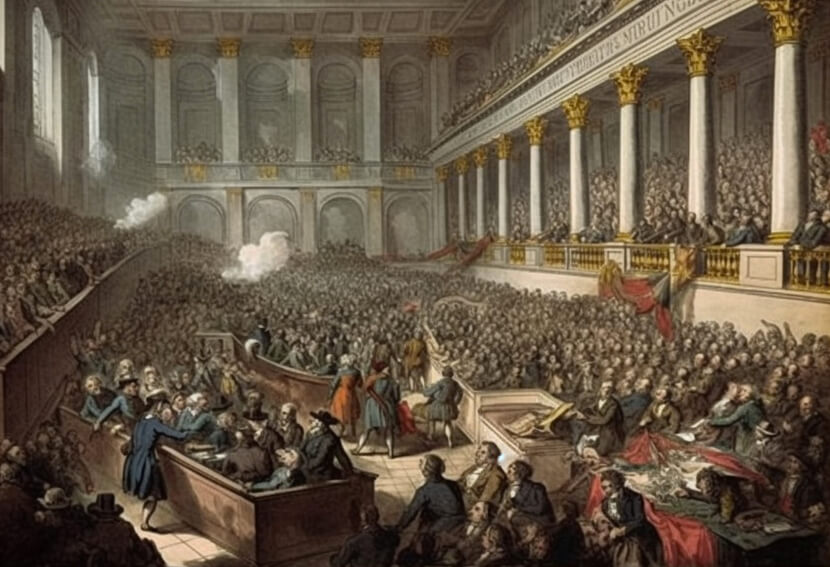
Nobody ever voted on the most important idea in modern politics, nobody debated it or ratified it, it simply walked in through the back door of a room in France and stayed. The year was 1789 and the National Assembly had a practical problem, too many voices and too slow a count, so deputies began arranging themselves by inclination, the ones pressing for deeper change drifting to one side of the president's chair and the defenders of the old order settling on the other, and researchers tracing the habit note the whole arrangement "was an accidental choice and it could easily have been the other way around,"1 sit somewhere else and you are suddenly the other team. From that accident we inherited the map almost everyone now uses to think about politics, a left, a right, and the comfortable assumption that every human being must fit somewhere on the line between them, and the strangest part is that nobody seems to mind, the most loaded concept in the modern imagination began as interior design, and it has never once left the building it was born in.
The Furniture and the Faith
Because that building was a parliament, and that parliament was bourgeois, everything the map could describe was already inside bourgeois society, and this is not a controversial claim among the people who noticed it first, it is simply what the genealogy shows. The left and the right were never theories of how society works, they were positions within a state, arguing over how that state should be managed, by whom and at what pace, which means that adopting the map is accepting the territory, since a spectrum whose two poles both presuppose the existing order guarantees that every disagreement on it stays a disagreement about management. A recent essay on precisely this question puts it flatly, the pairing "ensures all political conflict remains within bourgeois parameters," and its purpose, the author argues, is "to divorce politics from class,"2 replacing an objective conflict between people whose positions in production differ with a subjective squabble between people whose opinions differ.
The Italian communist Amadeo Bordiga saw the practical consequence early, watching fascism take his country while the left scrambled to explain it, and his 1922 report refused the obvious reading, insisting that "fascism is not a current of the bourgeois Right" but rather a reaction gathering all the forces that defend ownership, and that fascism owed part of its success to "the demagogic adroitness that the bourgeois Left has always been able to use in deceiving the proletariat."3 Both wings, in other words, were doing work for the same class, one with the whip and one with the apology, and the spectrum could not register any of this, because the spectrum has no column for who owns what, only for who sits where.
Teams You Join, Classes You're Born Into
Here is the difference the map exists to hide, and it comes down to what kind of belonging we are talking about. Membership on the left or the right is elective, you pick a team, inherit one from your family, change teams when the culture moves, wear the colors, boo the rivals, whereas class is not a selection at all, your relation to the means of production was decided before you ever formed a political opinion, by whether you live from selling your own labor or from hiring somebody else's, whether your income comes from wages or from what wages produce for somebody else. Nobody asks a worker on Monday morning whether he voted correctly over the weekend before deciding whether to extract surplus from his labor, and nobody refunds it to him if his heart was in the right place, a conservative worker and a socialist worker stand in the same relation to capital, and that relation is the thing doing the damage.
The defender of fascism is the hardest and most honest test of this, and there is no shortage of candidates, people who carry a boss on their back, a landlord on their neck, and a bank on their future, marching enthusiastically to defend the very system that stacked all three there. The left/right spectrum's explanation for them is moral, they are bad people, deceived people, backwards people, the wrong kind of fan, while the materialist explanation is colder and more respectful at once, because it starts from admitting they have a real grievance, precarity, dispossession, the quiet confiscation of what their labor created, a grievance that was carefully redirected toward other dispossessed people while the relation doing the damage was escorted offstage. That redirect is not an accident of dumb voters, somebody builds it, funds it, and keeps it running, and it cannot even be described from inside the spectrum, which has a slot for their opinion but none for their position.
The Axis Was Always a Timeline
Underneath the first smuggling operation there is a second one, more subtle. A left and a right are not just two locations, they are two directions on a single track, one pole promising to go faster and the other promising to brake, and the moment you accept the track you have accepted a theory of history, the track is already laid, the destination is already fixed or beside the point, the only question left is speed, and the name of that track is progress, "the left" being mostly the brand of the faster train. Walter Benjamin dismantled this decades ago, taking aim at the social democracy of his time, whose thinking was "determined by a concept of progress which did not hold to reality, but had a dogmatic claim," and in that imaginary progress was "the progress of humanity itself," a single subject moving together, and it was "something unending," with no destination anyone would ever have to answer for, and it was "essentially unstoppable," moving on its own so nobody would have to move it, every predicate performing the same quiet service of dissolving a fighting class into a patient species.4 Benjamin's verdict on the result is one of the most damning sentences ever written about the left: "There is nothing which has corrupted the German working-class so much as the opinion that they were swimming with the tide," and the logic of the corruption is easy to see, if time itself is doing the emancipating you only need a ballot and endurance, and the class "severed the sinews of its greatest power" without noticing.
Notice, then, how this machinery swallows Marxism itself, because once the track is assumed, a doctrine that rejects the whole layout can only be filed as maximum speed, the extreme left, the far end of acceleration, which is precisely how it is sold everywhere, a more radical version of the same journey. But Marxism never promised a faster train, it asked who owns the rolling stock, who laid the embankment, and who rides in which car without paying, and capital develops productive forces as no order before it ever managed, that is granted freely, while the same accumulation deepens the antagonism, generalizes the commodity, organizes the crisis, and reproduces the wage relation that makes workers workers, two movements, one process, with no net direction left over that you could call progress without smuggling in the passenger's point of view. Benjamin saw this too, remarking that what the old social democracy admired as a river of achievements was the same storm he watched pile "rubble on top of rubble," and closing the thought with the most quoted image in his theses, the angel blown backward into the future, "and that which we call progress, is this storm."5
"Beyond Left and Right" Has a Criminal Record
A word of caution before anyone gets excited, because "beyond left and right" is a phrase with priors. As I was going down this rabbit hole, I found that in the past, fascism has advertised itself as transcending the old parliamentary divisions, as a national union above petty party squabbles,6 and decades of third-way liberalism built entire careers on announcing the end of the spectrum while managing it perfectly, so the difference has to be located in what replaces the axis, since those moves stepped outside the team rosters to dissolve politics into something worse or into nothing at all, while the move described here replaces the axis with the class analysis it was designed to obscure. Stepping off the spectrum is trivial, anyone can do it and cynics do it daily, and what no position on the spectrum offers, however far left, is a substitute for naming the relation, and equality itself, pursued as a value detached from relations, is no refuge either, since equal rights between people standing at unequal starting points is what Marx called bourgeois right, a fairer race to the same exploitation. The useful question is whether your analysis names the relation or decorates it.
A Method, Not a Jersey
Marxism is not a position because positions are what the spectrum assigns, and it survived every attempt to file it in one, what it is instead is a method, an account of how history moves, why states behave as they do, why the rent went up while your wage did not, why the man with three creditors votes for the party of his creditors, and like any method it makes a modest demand, test it. You do not join it the way you join a club, you read it against your own week, and it either explains more of your material life than the alternatives or you set it down, which is also why it is not a faith, whatever certain sects have made of it, and the founder of Peruvian socialism, José Carlos Mariátegui, put the spirit of the thing better than anyone, insisting that socialism in the Americas "must be a heroic creation," made "with our own reality, in our own language," never a copy of anybody's blueprint.7
A practical discipline follows for anyone persuaded. Keep "the left" as an index, a convenient pointer to parties and habits everyone recognizes, but refuse it as a frame, and check yourself whenever it starts organizing your own sentences, because every time you say of a policy that it is right wing you have described an opinion and hidden a relation, and the hidden relation is always the one paying for the policy, so the discipline is small and it compounds, ask instead who owns, who owes, who commands the working day and who surrenders it, and name the class interest out loud, in conversation, in comment threads, over dinner, because the sentence that names the relation is the one the spectrum was built to keep unsaid. The map will survive one reader's defection, of course, but maps survive only while people forget they were drawn, and 1789 was a long time ago.
Footnotes
- W.G. Runciman, cited in Agence France-Presse, on the 1789 seating arrangement in the National Assembly: https://factcheck.afp.com/doc.afp.com.9PZ7D3
- "The Left is not a concept," Platypus Affiliated Society, 2021: https://platypus1917.org/2021/12/01/the-left-is-not-a-concept
- Amadeo Bordiga, "Report on Fascism," 1922, Marxists Internet Archive: https://www.marxists.org/archive/bordiga/works/1922/bordiga02.htm
- Walter Benjamin, "On the Concept of History," 1940, Thesis XIII, Marxists Internet Archive: https://www.marxists.org/reference/archive/benjamin/1940/history.htm
- Walter Benjamin, "On the Concept of History," 1940, Thesis IX: https://www.marxists.org/reference/archive/benjamin/1940/history.htm
- Gilles Dauvé, "When Insurrections Die," on fascism and democracy as paired management options: https://www.endnotes.org.uk/issues/issue-1/gilles-dauve-when-insurrections-die
- José Carlos Mariátegui, "Aniversario y balance," Amauta no. 26, 1928, Marxists Internet Archive: https://www.marxists.org/archive/mariateg/works/index.htm