Palestine: The Verdicts and the Deed
Part two: the courts, the ledger, and the work that falls to us
- capitalism
- fascism
- politics
- materialism
- palestine
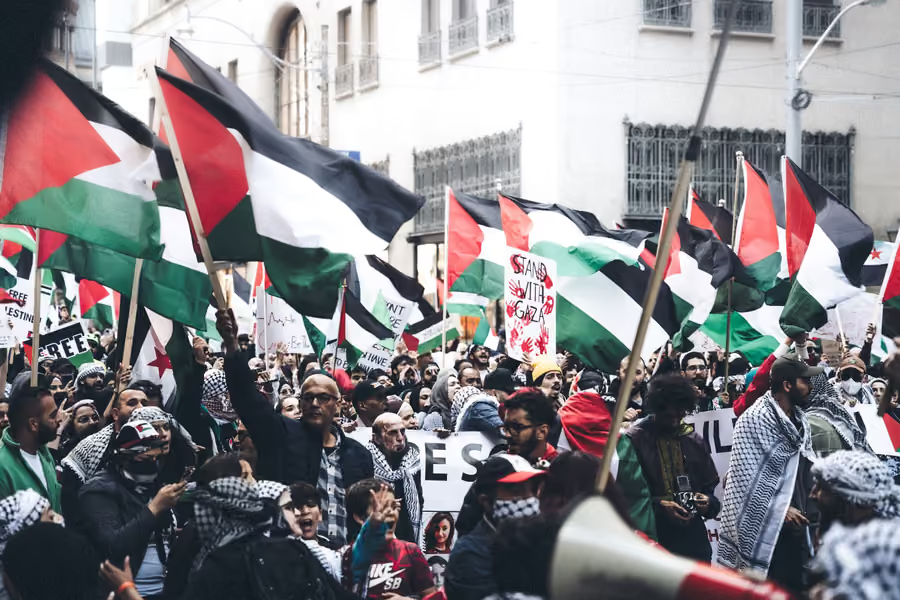
"We will continue to fight until the end, because we are not fighting for ourselves alone, but for all of humanity."
Leila Khaled
Fourteen against one
In September 2025, during a famine, the Security Council of the United Nations convened to vote on a ceasefire in Gaza, the sixth such attempt in two years. Fourteen of the fifteen members voted yes. The United States, alone among them, vetoed the demand. There was no theatrical argument, no extended explanation; a hand went up in a marble chamber on the East River and the resolution died, and the votes of nearly the entire assembled world died with it. This scene is worth holding in the mind's eye while the rest of this account unfolds, because it contains the entire political geometry of the story: the largest military machine in history, seated as a permanent member of the world's highest deliberative body, casting the deciding vote against stopping a catastrophe it simultaneously funds. The overwhelming majority of American vetoes at the Security Council, going back generations, have been cast to shield Israel from criticism of its conduct in Palestine. The veto is the political form of the material relation traced in the first part of this record: the guarantor's share of ownership expressed as procedure.
The order that produced the colony also produced the tribunals that now sit in judgment of it, and part two of this record follows what happened when that order's own courts were handed the evidence. Read the sequence that follows with one eye on the plaintiffs, because the plaintiffs are the story: the genocide case was carried by South Africa, the apartheid-prosecuting state whose own transition is living proof that the wall can fall; the case against the arsenal's largest European pillar was carried by Nicaragua, a small Central American state that the empire has invaded, mined and sanctioned, entering the World Court against the patron's oldest ally. It was the Global South that assembled the indictment of the colonial West, and it was the colonial West that punished the courthouses for accepting it.

The first verdict: occupation is unlawful
There are two courts and two different questions. The International Court of Justice is the tribunal between states. In January 2024 South Africa invoked the Genocide Convention against Israel and won provisional measures instructing it to prevent genocidal acts, a case that continues to this day. In July 2024 the same court delivered something larger, an advisory opinion requested by the General Assembly, ruling by eleven votes to four that Israel's continued presence in the occupied Palestinian territory is unlawful, that it violates the international prohibition on racial segregation and apartheid, and that Israel is obliged to end it "as rapidly as possible," evacuate the settlements, and pay reparation. The General Assembly followed in September with resolution ES-10/24, giving Israel twelve months to end its unlawful presence, a deadline that expired unheeded in September 2025. It is a striking thing to witness the highest court on earth find, on the merits, that the structure created by the 1917 letter and consolidated since 1967 is illegal from the ground up, segregation and apartheid named openly, and then watch the mechanism designed to enforce it dissolve into statements of concern. It is less striking once you remember who holds the veto pen, and who holds the factories.

The second verdict: arrest warrants
The International Criminal Court prosecutes individuals. On 21 November 2024 it issued arrest warrants for Benjamin Netanyahu and his former defense minister Yoav Gallant, charged with the war crime of starvation as a method of warfare, intentional attacks on civilians, and the crimes against humanity of murder, persecution and other inhumane acts. Israel never joined the court, but the charge sheet matters anyway, because it names the siege itself, the withholding of food from a civilian population, as the crime that it is. Enforcement is where the story darkens. Several European governments invented immunity theories to avoid ever having to act on the warrant. Washington sanctioned the court's prosecutors, an empire sanctioning a tribunal for applying its own doctrines, and the prosecutor who sought the warrants, Karim Khan, was removed from his post in July 2026 after a separate misconduct scandal, leaving the institution wounded and leaderless while its most prominent warrant remains in force. The patron had already shown, in the Security Council chamber, exactly how much respect it believed the law deserved.

The third verdict: genocide
The third verdict arrived from investigators rather than from a court. In September 2025, the UN Commission of Inquiry concluded that genocide has been committed in Gaza, and its chair, Navi Pillay, a South African jurist who spent her career prosecuting the machinery of apartheid, has since called plainly for Netanyahu to face a genocide trial. The word genocide carries a specific legal weight and an obvious rhetorical risk, and reasonable people argued for a long time about whether it applied. That argument, too, is closing. The real question, the one the verdicts leave on the table, is whether anyone will do anything about it.

After the ceasefire, the ledger
A ceasefire was declared on 10 October 2025 and marked with ceremonies; six hundred Palestinians were killed in Gaza in the months after it took effect, by the ministry's own counting. The occupation of the West Bank, the thing the ICJ actually ruled on, continues without interruption.
And then the purpose of all that destruction walked in and introduced itself. A prospectus has been circulating in Washington for what its authors call the Gaza Reconstitution, Economic Acceleration and Transformation Trust, a plan handing a century of leasing rights over Gaza's land to an investor consortium on the strength of a $100 billion development budget, with real estate tokens offered to owners in exchange for their claims, and Gaza administered from outside for at least a decade. The American president called the strip the Riviera of the Middle East. His son-in-law, a real estate developer by trade, surveyed the coastline and said what he saw: "look at this location on the sea, look at this beautiful piece of property". Behind the valuation stands the precondition: more than ninety percent of Gaza's housing destroyed or damaged, by the UN's accounting, its inhabitants displaced. This is the part of the process that never gets called by its proper name, the one every colonial venture rehearses: ruin creates value for whoever holds title afterward, and the people whose homes generated the valuation hold nothing but a token. The wall is the instrument, and the deed has always been the point.
In October 2026, Israelis went to the polls. Netanyahu's bloc came out of it with fifty-three seats, short of a governing majority; the bloc of his main challenger, Gadi Eisenkot, a former chief of staff of the very military documented in the first part of this record, held forty-eight, and Arab-led parties won a record nineteen, enough to make or break any coalition. What happened next is the most instructive part of the whole year. Every Jewish party but one refused outright to sit with the Arab parties, and Eisenkot himself ruled out any alliance with them, alleging that they support terrorism and deny Israel's existence. It is tempting, especially from abroad, to read the country's crisis as a Netanyahu problem, a personal corruption of an otherwise tolerable Zionism, one bad man to be replaced at the ballot box. The arithmetic says otherwise. The contest was between men who disagree about how the wall should be managed, run by a soldier or run by an indicted suspect, while the one bloc that questioned the wall itself, nineteen seats of it, was declared untouchable by all the others before the counting was even finished. There is no betrayal to be found in that arithmetic; the current management is Zionism itself, with the diplomatic asides removed.

The subordinate clause
Which brings the record back to the sixty-seven words where it began. Balfour promised a national home and appended a clause protecting the people already there, and every subsequent failure of the last century can be traced to treating the promise as binding and the clause as decoration; to privileging the promise of property over the fact of it. Jabotinsky drew the honest conclusion from that bargain, that consent was irrelevant and only force would do, and called it a wall. The courts have now said the quiet part in formal language: the wall stands on ground that is legally nowhere, its regime one of racial segregation and apartheid, and it is everyone's obligation, Israel's included, to end it without recognizing it or assisting it. The iron wall still stands, ruled unlawful and undisturbed by the ruling, while its chief suppliers bankroll it, its favorite model society polices its own streets with borrowed methods, and its most recent conquest is already subdivided into lots on someone's prospectus. Judges cannot enforce their own rulings. What they can do is remove the excuse of ambiguity, so that no government, no pension fund, no arms exporter, no investor in a trust leased against the ruins can claim not to know.

The voice we are lent
The courts did what courts can do, and the imperial order absorbed the blows, sanctioned the judges, vetoed the ceasefire and filed the prospectus, which leaves the account open exactly where each of us stands. There is a reason this century of documented, adjudicated, televised destruction has continued without consequence, and it is not that people do not know. It is that knowing has been carefully organized into a private matter, something to feel at a screen and carry nowhere, while the machinery that conducts the destruction runs on public money, public factories, public vetoes. Impunity of this scale is maintained neither by silence alone nor by secrecy; it is maintained by managed speech, by the slow negotiation through which each of us agrees to speak of other things. Palestinians in Gaza and the West Bank file testimony, film their own funerals, name their dead on lists that outlast them, and much of that record never crosses into the languages and feeds where the decisions are made. Between their documentation and our indifference sits the last viable distance the wall still owns.
Notice, finally, who managed to move this account even one inch: South Africa carrying the genocide case into the World Court, Nicaragua dragging the arsenal's European pillar before the same bench, a South African apartheid prosecutor delivering the finding of genocide. Every crack in the impunitiy has been opened from the Global South, by states that know the empire from the receiving end, and the empire's own institutions had to be shamed, sanctioned and sabotaged to close them again. That is the shape of the terrain on which we operate, and the reason every one of us holds some platform, however modest, that functions as infrastructure rather than vanity. A group chat, a workplace, a classroom, a blog with three readers, a family dinner where someone repeats a comfortable lie: these are the places where the account of what is happening is either transmitted or allowed to die. To write about Palestine now, to name the colonial character of what the West finances and the courts have condemned, is to occupy a position that people inside the wall are denied by force, and a position granted only by luck should be treated as a debt. None of this requires heroics. It requires refusing the privacy of conviction, putting the documented facts where they can be argued with, and joining the reproduction of the empire's silence the way one joins any supply chain, by withdrawing from it. Those who cannot speak have been silenced by design. Our task is to make the design fail, in the only terrain where each of us actually operates, which is speech.