Who the Cops Have Always Worked For
The documented origin story of the police, told as the long crime it is, and a question to bring to your next red light.
- capitalism
- fascism
- abolition
- police
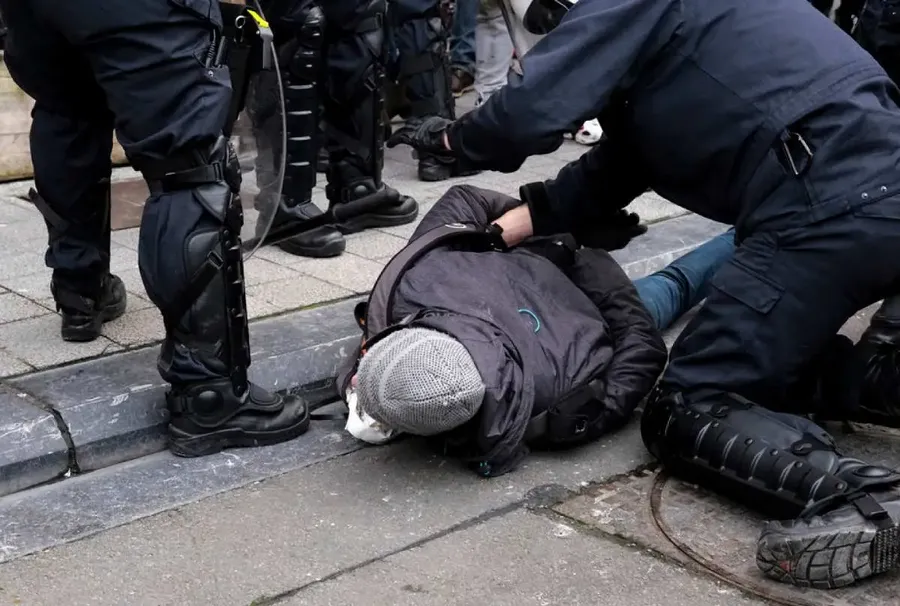
"In colonial regions... the proximity and frequent, direct intervention of the police and the military ensure the colonized are kept under close scrutiny, and contained by rifle butts and napalm."
Frantz Fanon, The Wretched of the Earth
There's a specific kind of quiet that fills a car when a police cruiser rolls up beside you at a red light. The radio goes down, your hands settle on the wheel like good instruments, and your eyes get suddenly fascinated by the dashboard, time standing still, waiting just in case the car says something. And it's worth noticing that nobody checks their mirrors to feel safer when the cops arrive, and that's a strange result for a public service. We are told policing is the thin line holding chaos back, so let's tell the actual story, because unlike Batman's, this one is documented, and it goes badly from the first page.
The job existed long before any crime did
The first patrol on a payroll shows up in the Carolinas in 1704, and its whole job was catching enslaved people who ran, terrorizing the ones who stayed, and walking into any home without a warrant whenever the mood struck.1 No homicide unit, no investigation of the plantation's many crimes, because the patrol existed to protect one man's investment and keep a workforce scared enough to work for free forever. The first cops in the Americas were HR for plantations. Hold that image, because everything that follows is a variation on it, including what happened on the other side of the map, my side of the map, on a river you can throw a stone across.
Canada opens a branch office on freedom's river
That river is the Niagara, and for decades it was the last stretch of the Underground Railroad, the water Harriet Tubman carried people across into what was supposed to be the end of the chase. Then 1865 arrives, slavery collapses next door, and Canada responds by founding the Niagara Frontier Police to patrol that same crossing.2 A locally printed commemorative book lists the founding duties without blinking; catching the illegal aliens coming over the border, and enforcing temperance so working men drank only what the province approved. Same travelers, new adjective, and the paperwork flipped almost overnight. The founder, Gilbert McMicken, was prime minister John A. Macdonald's spymaster, running agents through Buffalo and Detroit to spy on Irish organizers,3 and his police lines eventually fed into both the Ontario Provincial Police and the RCMP. Same dog, different collar. The men who chased freedom seekers up the riverbank became the ancestors of every badge in the province.

The guns come back around on the workers
Macdonald had more work for that kind of muscle. In 1873 he sent the North-West Mounted Police west to clear the plains for settlement, and Parks Canada, the government's own cheerleading department, admits the point was taking control of the territories without asking anyone who lived there.4 The Mounties confiscated land, enforced the starvation policies of the day, and by 1933 the Indian Act had them working as truancy officers, hunting down children and delivering them to residential schools.5 That confession sits on the RCMP's own website, in a timeline section, next to commendations. A force that spends generations taking land and kidnapping kids makes the word servant in civil servant sweat.
So when the predictable happened in Winnipeg in 1919, thirty thousand workers walking out and shutting the city down, the question was never whether the mounted police would fire on the crowd, only how many would die finding out. June 21, Bloody Saturday, the Mounties charged with pistols drawn, firing around an overturned streetcar. Mike Sokolowski, a Ukrainian immigrant, was shot through the heart and died on the pavement outside a theater. Steve Szczerbanowicz took two bullets in the legs and died of gangrene two days later.6 The army then occupied Winnipeg, one of the only times Canada has put its own city under military rule, and the strike leaders who weren't jailed got deported. The beautiful detail is that the city police had voted to strike too, and the strike committee asked them to stay on duty anyway, a level of faith in public service you almost can't picture today. The plains-clearing force was forty-six years old when it turned its pistols on farm hands and factory workers, which tells you the training was never about Indians or Ukrainians specifically. The training was about whoever the boss pointed at.
Fifty-three years of waiting ends with a bullet
Ontario's provincial force got its own entry in the ledger at Ipperwash in 1995, and the story there is older than the shooting. Kettle and Stony Point families occupied a park to stand on burial grounds the government had confiscated in 1942, promising to give the land back after the war, and the war in question was World War Two. Fifty-three years of waiting, then the OPP walks in with shields and guns against a few dozen unarmed people, and Acting Sergeant Kenneth Deane shoots Dudley George dead. Deane was convicted of criminal negligence in 1997 and then died in a car crash shortly before he was scheduled to testify at the inquiry, which eventually found the institution itself responsible for the tragedy,7 a finding that in practice amounted to a memo with feelings. Buried bones, that was the emergency, and the land under them was the asset.8
Read the Wet'suwet'en raids of the last few years and you realize Ipperwash never ended, it just got a contractor and a helicopter budget. The RCMP runs a unit called the Community-Industry Response Group, a name that admits the assignment on the letterhead, and since 2019 it has carried out armed raids against land defenders on unceded territory, protecting a pipeline whose company never obtained the consent of the hereditary chiefs the pipe crosses.9 Complaints against that single unit reached 572 in three years, enough to force a systemic review, and the review is still going while the unit keeps working.10 Somewhere in a boardroom, somebody found it perfectly reasonable to invent a police squad named after the industry it serves, and nobody stopped them, which tells you the system is not broken. The system is the problem, running exactly to spec.
The largest mass arrest needed no crimes
Toronto caught a fuller glimpse of the spec at the 2010 G20, when 1,118 people got arrested in a weekend, still the largest mass arrest in Canadian history. Riot police kettled entire blocks, pedestrians included, holding hundreds in the rain at Queen and Spadina, and most of the detainees walked free days later without ever being charged. The city settled for $16.5 million,11 and the judge reviewing the commanding officer called his conduct a lack of understanding of the right to public protest. Lack of understanding, they said. When I misunderstand my job, someone's Wi-Fi malfunctions, but when they do it, a thousand people sleep in a cage and the taxpayers mail out the apology.
The plantation reopens with shareholders
The cage is the product, more on that shortly, but the road leads through the border first, because the United States took the plantation HR and simply reopened it with a federal badge. ICE now runs on arrest quotas, over seventy percent of the people in its detention system hold no criminal conviction,12 and street arrests have multiplied, while in the first year of the program's expansion more people were arrested without a criminal conviction than in the entire previous system combined.13 A quota of three thousand captures a day is not investigation, it's a hunt, and the circle closes back to 1704 like the whole thing was a rhyme scheme. The patrol rides again, and the people it rides for have shareholders now.
The everyday version barely makes the news
Meanwhile, up here, the mundane version of the same machinery hums along. In Montreal, officers got suspended this year for humiliating unhoused and racialized residents, and we only know because other cops reported it, which says plenty about the ones who didn't.14 Over twenty-two thousand tickets landed on homeless people in Montreal in a single decade, and most of those convicted went to jail, for the spectacular offense of not having the money to pay.15 And where I live, the spreadsheet reads the same. Bob Allen froze to death downtown in January 2025, at minus eight, after being turned away from a shelter system that runs 275 beds for the whole region,16 and the council debate that followed was whether to open cold-weather shelters at zero degrees instead of minus ten. They voted no.16 Our mayor then co-signed a letter asking the province to invoke the notwithstanding clause, the constitutional override, for the specific purpose of clearing encampments when the shelters are already full,17 so the tents get torn down and the people inside them go back to the sidewalks that are illegal to sleep on. The police bill that enforces all this is $236.9 million for 2026, an 11.5% jump,18 and on the average Niagara tax bill the police line runs $1,013 against $122 for housing.19 Eight to one. You can read a city's whole morality off its budget spreadsheet, and ours is a cop with a shopping cart.The warehouse where obedience is manufactured.
Then there's the warehouse. Prison is where the road ends for the people this system trips up, and the official story says it's about rehabilitation, while the ledger says something else. Prisoners working for CORCAN, the federal prison industry agency, top out at $6.90 a day, a ceiling worth less now than the one from 1981, and refusing the work gets you punished, sometimes with more work.20 The furniture is a side business; what a prison mass-produces is obedience, felt hardest by the people who never go inside, because every worker outside the walls knows what the basement of the economy looks like and who's in it.

The body count with a billing address
Now the part that should genuinely enrage people. A kid carrying a bag of weed can lose years of his life behind a door. A boardroom that signs off on marketing opioids, on skipping the safety upgrade, on dumping waste where people drink, racks up a body count no single criminal could match working full time, and the punishment lands on a company name; a fine, negotiated down, stretched across a quarter, sometimes literally deductible as a cost of business. There's no chalk outline for a death caused by metrics and objectives. Display the petty crime to justify the spending, demonize the hoodie, glorify the suit, and only one of those outfits will get strip-searched. Corruption kills through abstraction, which is exactly why it never sees the inside of a cell, you can't handcuff a company logo.
Order for a machine that manufactures disorder
Strip away the costume and the machine underneath is simple. A force paid from the public purse to keep order inside a system that manufactures disorder, rents that swallow paychecks, jobs that evaporate, food bank queues around the block, and a man sleeping rough fined for existing in the wrong posture. Study after study lands on the same boring conclusion, that the safest neighborhoods are the ones with steady income and stable housing, and no taser has ever produced either. Most of what we call crime is a rent problem or a wage problem, and a fat slice of what's criminalized wouldn't be crime at all in a society where food, housing and healthcare weren't paywalled, sleeping outside is only illegal because sleeping inside costs money. Law enforcement is not the foundation of safety; living conditions are, and the cops end up working as debt collectors for a society that refuses to build any.
Run the experiment yourself
So do the experiment. Next time a police cruiser pulls up behind you, or slides alongside at a light, watch what your shoulders do. Notice your breathing, count the seconds until it turns off somewhere else. Then ask yourself, honestly, no anthem playing in your head, whether the institution tightening your body at a red light is protecting you, or protecting property near you and billing you for the service. Look at your city's budget, look at who gets prison and who gets an invoice, look at the story above, which is not a list of accidents, and try to defend it with a straight face. Hard to do. Say out loud what you already feel at that light, that the police shouldn't exist in this form, that safety is built with apartments, clinics and paychecks, and that every dollar of it shows up before the badge does or not at all. The uniform has receipts going back three centuries, and not one of them is made out to you.
Sources
- American Bar Association, human rights journal, "How You Start Is How You Finish: Slave Patrols and the Origins of Policing"
- The OPP Museum's Historical Highlights, confirming the 1865 Niagara Frontier Police as a provincial policing ancestor. The commemorative origins book itself, special collection, St. Catharines public library
- David A. Wilson, Canadian Spy Story: Irish Revolutionaries and the Secret Police, McGill-Queen's University Press, on McMicken's frontier surveillance network
- Parks Canada on the creation of the North-West Mounted Police
- The RCMP's own Indigenous relations timeline on the 1933 truancy appointments
- CBC News, "Bloody Saturday: 1919 strike turns deadly", on the Sokolowski and Szczerbanowicz killings and the military occupation of Winnipeg
- Hedican, "The Ipperwash Inquiry", on the inquiry's findings
- Amnesty International's pre-inquiry brief on political pressure for tactical action at Ipperwash
- Amnesty International Canada's Wet'suwet'en report on C-IRG raids
- The Civilian Review and Complaints Commission's tally of 572 C-IRG complaints
- The Guardian on the G20 class action settlement and the misconduct ruling
- TRAC Immigration's detention quick facts
- The Deportation Data Project's enforcement analysis
- CBC News on the suspended SPVM officers
- Public Safety Canada's archived study on the ticketing of homeless people in Montreal
- CBC News, "New coalition to host forum on homelessness crisis in Niagara", on Bob Allen's death, the rejected zero-degree shelter threshold, and the region's shelter capacity
- CBC News, "Ontario mayors ask Ford to use notwithstanding clause to clear homeless encampments"
- The Pointer on regional council rejecting the NRPS budget and the 11.5% hike
- Niagara Region's 2026 budget page, the itemized property tax breakdown
- Broadview Magazine on CORCAN wages and forced prison labour